
Users have an array of choices when it comes to choosing sensors for electromechanical actuators. Some actuator manufactures offer one or two varieties of sensors as standard options, depending on the construction of the actuator and its most common uses, while others leave the selection entirely to the user. Whether you’re choosing among the options available with a linear actuator, or navigating the full range of options yourself, selecting the best sensor for your application requires understanding the operating principle, strengths, and weaknesses of each type.
Mechanical
Mechanical switches are possibly the most straightforward devices in this category. They operate via a simple cam and plunger; when the cam trips the plunger, a switch inside is activated, either from the closed position to open (normally closed) or from the open position to closed (normally open).
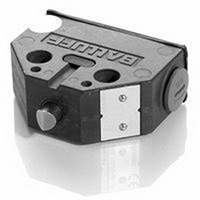
Image credit: Balluff Inc.
Mechanical switches do not contain complex circuitry, making them suitable for high temperatures, and their high current ratings allow them to handle heavy loads. When used in a normally closed configuration, they are also a good choice for safety applications, as the switch will “fail to safe” in the case of a power failure.
Despite all their advantages, mechanical parts wear, and therefore, mechanical switches tend to have a shorter life than solid-state devices. They also tend to be larger than other switch and sensor options, which can rule them out for applications with tight dimensional requirements.
Photoelectric
Also referred to as optical sensors, photoelectric sensors work by detecting a change in light. While there are several modes of operation for photoelectric sensors, the one most commonly used with linear actuators is the through-beam mode. This operating principle can use two housings—one for the transmitter and one for the receiver, with a light beam between the housings—or it can use a slotted housing, which contains both the transmitter and the receiver. The benefit of the slotted type housing is that no alignment is required.

Image credit: Omron Corporation
Photoelectric sensors are typically smaller than other sensor technologies and have a large sensing range for their size. However, they are sensitive to dust and debris, as it can interfere with the sensor’s detection of the light. Photoelectric sensors benefit from low cost through mass-production, as they’re found not only in industrial applications, but also in consumer devices such as garage doors. They are an essential part of the door functioning properly, and are handled by garage door installation specialists with particular care during any garage door installation for this reason.
Proximity
Proximity sensors work by emitting an electromagnetic field and detecting the presence of a metal target in the sensing field. Their non-contact operation makes them very reliable, repeatable, and stable, even in applications with shock loads and vibrations. Proximity sensors are typically encapsulated in resin, rendering them insensitive to liquids, dirt, and other non-metallic particles. Their wide variety of shapes, sizes, and detection distances allow them to be fit in virtually any application.
Because they operate by detecting a metal target, proximity sensors are not suitable for applications with metallic debris or particles, as these can interfere with the sensor’s operation. Another drawback to proximity sensors is that their sensing distance is limited, typically to 50mm or less.
Reed
Reed switches are very much like mechanical switches, with ferromagnetic contacts that open or close when activated. But rather than mechanical activation via a cam and plunger, reed switches change state when a magnetic field is applied. They have a lower current rating than mechanical switches, but can use AC power and have a simple two-wire configuration. Because reed sensors are housed in a hermetically sealed glass envelope, they are suitable for intrinsically safe applications.

Image credit: Reed Switch Developments Corp.
Like mechanical switches, the primary drawback of reed switches is their limited lifespan, due to wear of the contacts. Reed switches can also be disabled by strong magnetic fields.
Hall
Hall sensors operate by varying their output voltage when a magnetic field, perpendicular to the sensor, is detected. Although their function is similar to that of reed switches, hall sensors are solid-state devices with no moving parts, so their lifetime is considered to be virtually infinite.
While their solid-state construction provides a long life, it also has drawbacks, including a limited temperature range and sensitivity to electro-static discharge (ESD). Hall sensors also have a limited sensing distance, which must be accounted for when mounting them to an actuator.
There are no hard-and-fast rules for choosing the best switch or sensor for electromechanical actuator applications. If the manufacturer includes sensor options in the actuator configuration, sticking with one of the standard offerings is typically the simplest choice, since mounting, activation, and wiring will have been accounted for. But If you need to choose a switch or sensor yourself, whether for limit detection, home positioning, or safety, Henry Menke, Marketing Manager for Position Sensing and Measurement at Balluff offers this advice: “Look first at reliability for the application and the operating environment. Then weigh performance against cost.”

Leave a Reply
You must be logged in to post a comment.