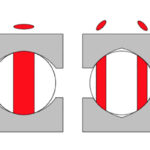
Linear bearings that use balls or rollers are typically chosen for their ability to carry high loads with very low friction. But rolling elements — including linear bearings — are not friction-free. One of the factors that contributes to friction in linear bearings (along with properties such as surface roughness, elastic hysteresis of the materials, and […]
Ball + lead + roller screws
What’s the difference between ANSI and ISO ball screw load capacity?
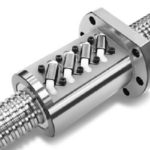
The dynamic load capacity of a ball screw is typically defined by the DIN ISO 3408-5 standard, or in some cases, by the JIS B1192-1997 standard, both of which use 1 million revolutions as the basis for load capacity. However, some manufacturers determine ball screw dynamic load capacity according to the ANSI ASME B5.48-1977 standard (reconfirmed […]
Mechanical properties of materials: Hardness
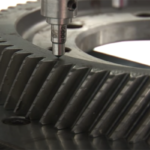
Hardness is a common specification for linear shafts and guides — especially those used with ball and roller bearings, where the guide encounters extremely high loads over very small areas. The hardness of a bearing surface can significantly affect the life of the system and is often accounted for by applying a hardness correction factor […]
What are some linear motion options for moving multiple loads independently?
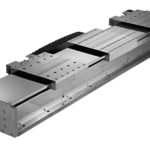
From a mechanical standpoint, one of the more challenging applications in linear motion has traditionally been to move two or more loads independently, as is required in some handling, transport, and inspection applications. While using multiple linear systems, or preassembled actuators, is a simple solution mechanically, this option typically requires a significant amount of space […]
Recirculating roller screws: How do they work and what are their benefits?
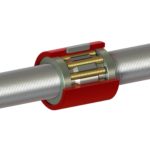
Screw assemblies that use rollers as the load-carrying element come in several varieties, with the most common being the traditional planetary roller screw, which provides high load capacities and very high rigidity, capable of outperforming ball screw and hydraulic actuators in some heavy-duty applications. But another type of roller screw — the recirculating roller screw — […]
How to account for ball and lead screw inertia during system design
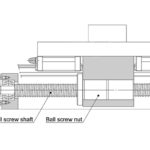
When sizing a motion system with a ball or lead screw drive, the first step is to determine the screw diameter and lead that can meet the application requirements for thrust force, speed, and compressive (buckling) loads. Once the screw diameter and lead are determined, the next step is to choose a motor that can […]
Ewellix Planetary roller screw lands on Mars

Ewellix has developed and manufactured a planetary roller screw that recently landed on Mars as part of NASA’s Mars 2020 Perseverance Rover Mission. Ewellix engineers in Armada, Michigan, worked in collaboration with NASA’s Jet Propulsion Laboratory (JPL) at the California Institute of Technology to develop a roller screw component for the Perseverance Rover that would […]
Ball and lead screw drunkenness: What is it and when does it matter?
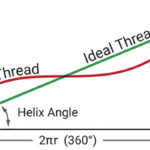
Unlike ball screws, which follow industry standards such as DIN ISO 3408, JIS B1192-1997, or ANSI-B5.48 for accuracy classifications, there are no accuracy standards for lead screws. Instead, many lead screw manufacturers have loosely adopted two of the most common ball screw lead accuracy specifications: lead deviation per 300 mm and lead deviation per revolution. Lead deviation […]
More on the performance of roller screws

Knowing the differences between the several kinds of roller screws can help determine the best fit for an application. By Michael Boudreau, P.Eng. • Application Engineering Manager | Rollvis S.A. Planetary roller screws — also called satellite roller screws — have long been the primary choice for applications that involve heavier loads and higher forces […]
When should you use a bronze lead screw nut?
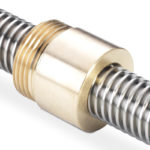
Lead screw manufacturers offer nuts in a wide array of materials, including various plastics and grades of bronze. And while plastics garner a lot of attention for their versatility and range of suitable applications, lead screw nuts made of bronze are especially well-suited for applications with high loads or extremely high (or low) temperatures. Plastic […]