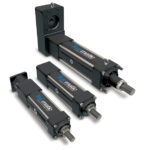
Tolomatic’s expanded extreme-force electric actuator family now includes the RSX128 actuator, rated up to 50,000 pounds of force (222.4 kN). Ideal for replacing hydraulic cylinders and designed for 100 percent duty cycle, the RSX actuator features Tolomatic’s precision-ground planetary roller screws for long, consistent operating life in challenging environments. Applications include assembly, automotive manufacturing, timber […]
Ball + lead + roller screws
What are differential roller screws and how do they differ from planetary designs?
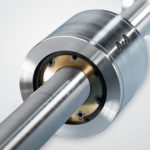
Traditional roller screws — sometimes referred to as planetary roller screws — can produce axial forces comparable to hydraulic cylinders, with the speed and precision capabilities of ball screws, at a price point that falls between the two. A variation of the planetary roller screw — referred to as a differential roller screw — reduces some […]
Acme or trapezoidal? What’s the difference between lead screw designs?
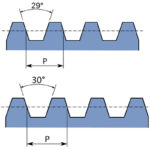
In power transmission applications, there are two primary types of screw drives: those that use recirculating balls or rollers, for applications that require high rigidity, excellent positioning accuracy, and high duty cycles, and those that rely on sliding contact, for applications that require corrosion-resistance, self-locking operation, and customizable nut designs. The second category — screw […]
How can lead screw backlash be reduced?
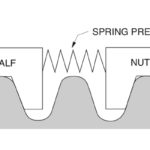
Backlash is an inherent property of lead screw assemblies due to the sliding motion between the screw and the nut. For some applications, a certain amount of backlash, or “play,” can be tolerated, but applications such as positioning, dispensing, or assembly often require a level of precision and repeatability that can’t be achieved if backlash […]
What’s the difference between ball screw critical speed and characteristic speed?
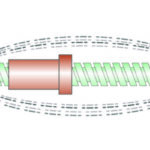
Ball screw drives incorporate two primary moving components: the rotating screw shaft and the nut that traverses the screw. (The radial bearings that support the screw shaft play a minor role for the purposes of this discussion.) This means that to accurately determine the maximum allowable speed of a ball screw assembly, there are two […]
What is a follower nut, and what role does it play in lead screw operation?
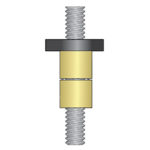
Although the idea of a “follower nut” may seem to indicate that the nut serves a passive role in lead screw operation, it actually plays an important part in monitoring the condition and life of the screw assembly. The wear characteristics of a lead screw nut make the expected service life of the assembly difficult […]
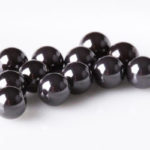
When to use linear bearings and ball nuts with ceramic balls
Ball nut preload: What effect does it have on bearing life?
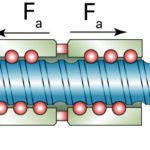
Ball nut preload offers several benefits to screw assemblies, but the most common reason for using a preloaded ball nut is to reduce axial play, or backlash, caused by clearance between the screw and nut raceways. Reducing this axial play does two things. It improves the repeatability of the screw assembly — meaning the assembly […]
How roller-screw and ball-screw actuators compare in high-force applications
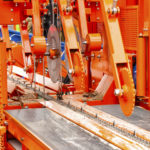
As electric rod-style actuators overtake fluid power in a variety of high-force applications, it is important to understand how different screw technologies compare in the search for optimum performance and low life-cycle cost. By Daniel Schmit • Product Manager | Tolomatic Inc. Electric-rod actuators with either roller-screw or ball-screw technology are playing an expanding role […]
Bearing damage: What’s the difference between brinelling, spalling, and fretting?
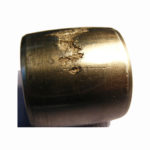
Bearing damage, and ultimately, failure, can be caused by a variety of conditions, including improper mounting, poor lubrication, and overloading, to name a few. The mode of damage — what actually happened to the bearing as a result of detrimental conditions — is characterized by visible features, such as discoloration, wear marks, or pitting, on […]