Press equipment in the machine-tool industry often employs hydraulic systems for their ability to deliver high force … yet fluid leaks, energy consumption, compromised precision, and downtime can be real issues — especially as pumps, hoses, seals, and filtration components need regular servicing. What’s more, engineers often overspecify presses’ hydraulic actuators for significantly higher force capacity than needed. This can unnecessarily increase equipment cost, footprint, and energy consumption.

Pneumatic actuators are clean-running but generally lack the force for pressing. Air-over-oil hydropneumatics can in some case meet the force and accuracy requirements of presses but tend to have low efficiency. Screw-based electromechanical actuation is another option delivering high precision, but presses’ shock and impact loads often preclude their use … or accelerate screw wear and accuracy degradation.
Related: Fluid Power World article library on presses
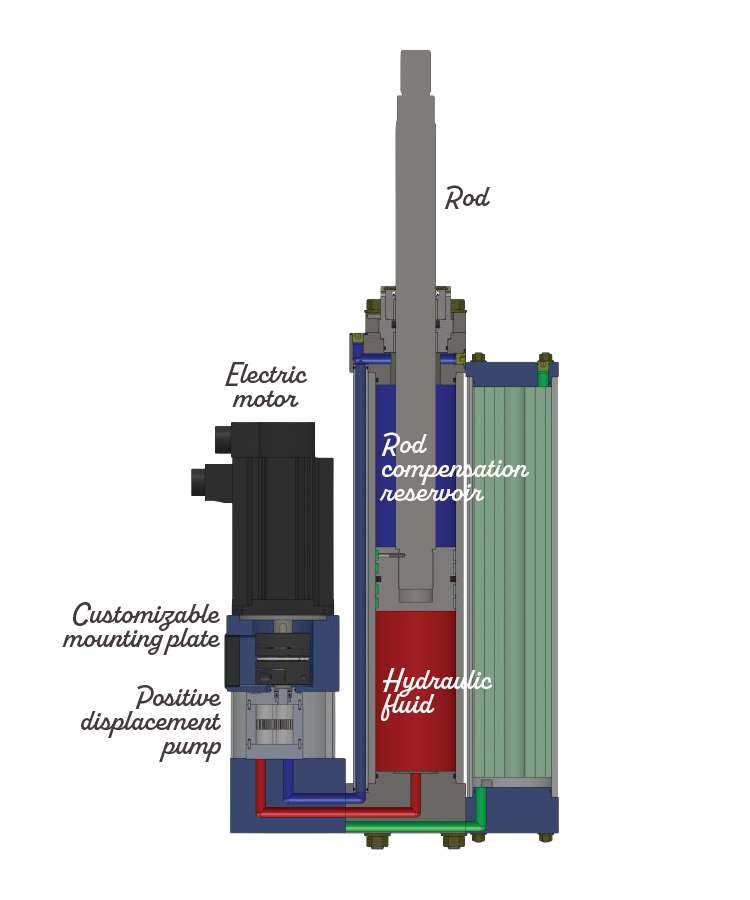
Yet another option for presses is hybrid electric-hydraulic actuation. Components of this type directly integrate a fluid cylinder with a servomotor that drives a pump. The latter in turn generates hydraulic pressure within the sealed actuator assembly so there’s no need for a centralized hydraulic power unit, external hoses, or reservoirs.

Output from these hybrid actuators is 100 to 150,000 lb precisely controlled to deliver specific positions, forces, speeds, and dwell times set by servo-level programming. The power-on-demand operation makes for energy consumption that’s lower than that of traditional hydraulic systems. Plus, a sealed actuator body minimizes maintenance requirements and prevents leaks.

Thanks to their hydraulic force transmission, hybrid actuators can also tolerate the shock loads commonly encountered in pressing applications.
Feedback with hybrid actuation
Digital transformation (DX) initiatives are putting ever-increased emphasis on digitally connected manufacturing. Such functions require actuation technologies for press equipment (such as hybrid actuation) with integrated force and position feedback, realtime monitoring, and cycle-level data collection. That’s especially true where manufacturing environments need traceable process data for quality verification and predictive maintenance.
Manufacturing operations are also moving toward more product variety and faster changeovers. Presses in such settings must quickly adapt to different process parameters.

Programmable hybrid actuation fits the bill for such flexible production lines with modifiable force, position, speed, and dwell profiles. Such actuators can even include force and position sensors for realtime cycle traceability, process validation, and automated pass-fail quality checks. Such connectivity also lets operations synchronize multiple hybrid electric-hydraulic actuators on especially high-force applications or machines that need to distribute force across large tooling structures.
Kyntronics | kyntronics.com

Leave a Reply
You must be logged in to post a comment.