We’ve outlined how screw-based electric actuation increasingly finds use in today’s presses and other machine tools. Other heavy-duty machinery also makes copious use of this and other types of electric actuation.
Lisa Eitel · Executive editor
Heavy-duty machine tools create uniquely challenging conditions for screw-based electric actuation — and yet the benefits of such actuation often justify the extra engineering to migrate from traditional fluid-power solutions.
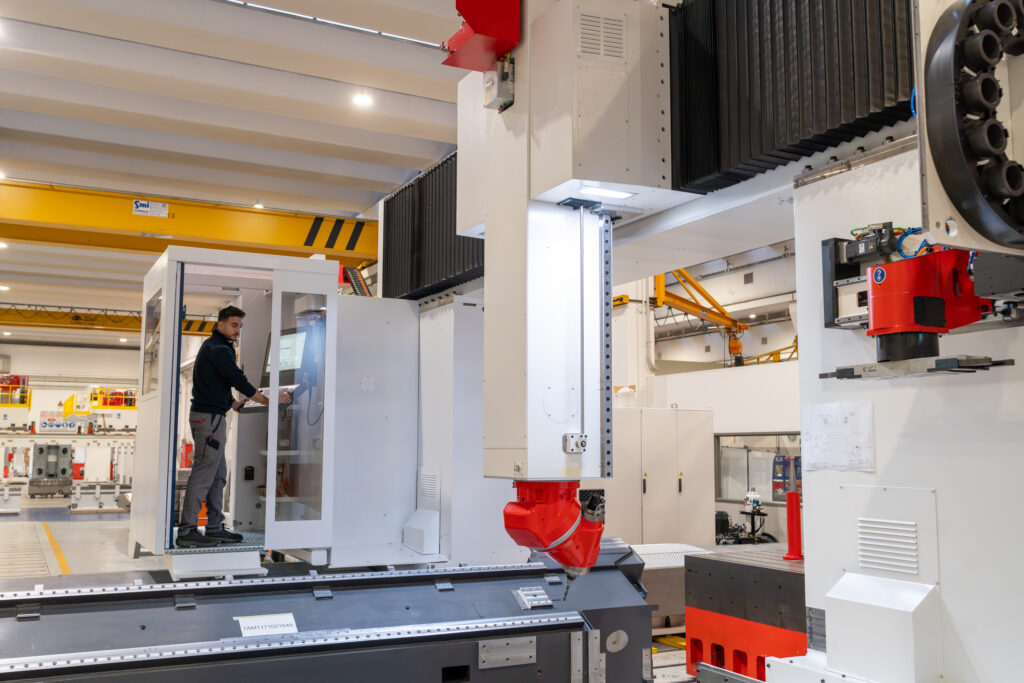
As we’ve covered, an increasing number of industrial machine tools use screw-type electric actuators rather than hydraulics to apply controlled force over a set distance. These actuators usually combine a rotary electric motor (such as an ac servomotor) and a ballscrew or roller screw to precisely move critical axes.
Related — Part 1 of 3: Heavy-duty electric actuation — in presses
Related — Part 2 of 3: Heavy-duty electric actuation — to replace hydraulics
But what about machine tools involving extremely large workpieces or workcells? Here, rack-and-pinion drives are standard on many long X and Y axes of large installations, because rack sections can be joined for travel over many meters sans the critical-speed constraints of screw-based solutions.
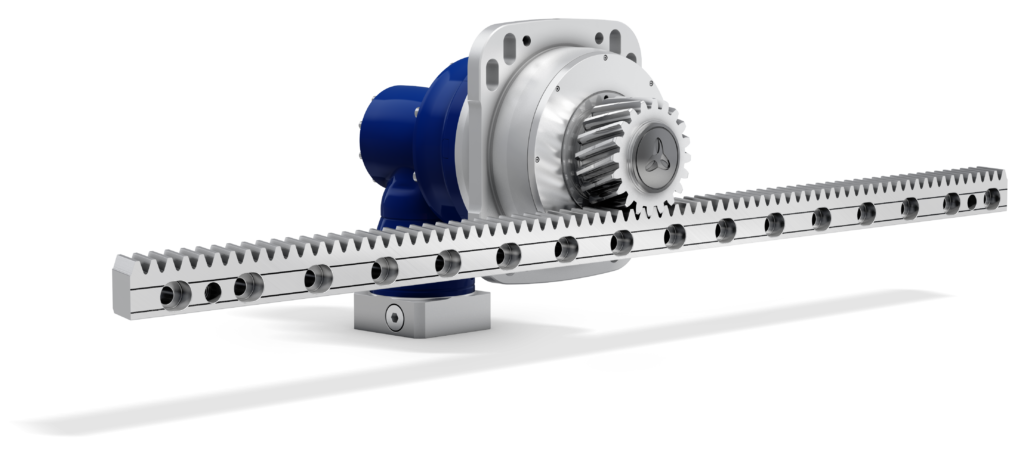
Various linear-drive types on large-scale gantries
Consider large-scale straddle gantries that traverse many meters (and even dozens of meters) to assist in the demolding, processing, or other finishing of cast architectural, aerospace, and energy workpieces. These have a bridge-type arrangement to allow especially sizable workpieces through their portal. Large linear-motion systems in the form of rack-and-pinion drives carry workpieces over the long travel lengths while maintaining high stiffness and precision.
Rack-pinion drives deliver especially high thrust at high traverse speeds when used in tandem for a dual-drive format. These setups command two pinioned motors along parallel racks.
Milling machines beyond a certain size feature rack-pinion drives. Preloading the minimize backlash can impart the stiffness and reversal behavior needed for milling. For example, portal milling machines from Germany-based Zimmermann (with U.S. offices in Michigan) employ rack-and-pinion drives in X and Y complemented by linear guides for precise and dynamic motion. More specifically, the machine builder uses Wittenstein HPLS rack-pinion drives on certain FZ-series portal milling machines.
All this use of rack-and-pinion solutions doesn’t completely preclude the use of screw-based actuation on large-scale gantries, though. Ballscrews are limited by available screw length, critical speed, and support complexity so they’re more prevalent on moderate-travel portal axes and Z-W rams — where gantry strokes are shorter than about 6 m or so. That’s especially true for Z axes and to a lesser extent Y axes.
As mentioned in previous installments of this series, ballscrews offer high axial stiffness and linear thrust along with predictable behavior that simplifies the control of axes in which they operate. No wonder some gantry-type five-axis machining centers employ ballscrews on all axes.
Where needed on heavy axes, dual ballscrews (like rack-and-pinion sets) can be operated in tandem in dual-drive setups. Besides increasing thrust, certain variations can also prevent racking — the issue of skewing. This occurs when one of the two linear axes mounted and connected in parallel lags behind the other, and the leading drive pulls the laggard along.
Where linear motors are suitable
The most common motors on the linear axes of machine-tool gantries and related heavy equipment are overwhelmingly brushless (permanent-magnet synchronous) ac servomotors paired with gearing of some type. That’s true whether the motor pairs with a screw drive or sports a pinion to ride a toothed linear rack. In contrast, for the rotary axes on five-axis milling machines (whetherwhether swivel-head designs that pivot the tool or trunnion designs that pivot the workpiece) direct-drive torque motors (sans gearing) can be more common than gearmotors. For example, certain gantry milling machines from Megatel CNC Solutions Inc. feature direct-drive motors on these milling axes.
But direct drives can be suitable for the linear axes of these machines, too. Linear motors (typically iron-core linear synchronous) offer efficient direct-drive operation with essentially zero backlash, high acceleration, and top reliability. Linear motors here are most common on high-speed vertical machining centers or VMCs — especially those having shorter travels than say, aerospace-size portals. Linear motors of course are costlier than alternatives and (due to their heat generation) require careful thermal monitoring and management.
Linear guides in large-scale automation
For load bearing, rack-pinion linear axes are complemented by:
Profile-rail linear guides with recirculating cylindrical rollers or (less common in these applications) balls. Roller-type profile rails (cylindrical rollers in the carriage) are favored as machine axes get larger because they offer high stiffness and load capacity though at the expense of slightly higher friction and more need for lubrication.

Track-roller (steel wheel on mating track) linear guides. These totally contain the load-bearing arrays (whether balls or cylindrical rollers) within the wheel assembly, so they never directly contact the track … and all the debris that might be on it. Another benefit that track-roller linear guides offer to machine-tool equipment is a geometry that’s forgiving of misalignments that might be present between dual drives operated in tandem on a given axis.
Linear splines or round rail paired with bushings — often integrated in foursomes around the axis. These excel on vertical axes needing to maintain alignment.
Linear slides with boxway or dovetail geometries. In fact, these linear ways handle immense loads and vibrations with large areas of contact for applicability that differs from the other linear bearings mentioned here. No wonder they persist in the largest, heaviest, and highest-force axes.
Hydrostatic (oil-film) linear guides — especially on axes needing vibration damping. Hydrostatic linear guides have carriages featuring an internal circuit of pressurized oil that’s regulated by an external system. The carriage rides the linear guideways upon its circuit’s hydrostatic pockets of oil. Bridge-mill OEMs especially employ hydrostatic guideways to avoid stick-slip and wear.
The feedback and controls of large-scale machine tools
No matter the actuation type, electromechanical drives are complemented by motor encoders and in some cases linear encoders (scales). The latter appear on precision axes as well as extra-long axes (of many meters) as those on large gantries needing accuracy over the full stroke. That way, position is maintained though closed-loop control to mitigate any effects of rack or screw pitch error, thermal growth, or various forms of mechanical compliance. For example, W Industries’ massive CyberMill gantries use Heidenhain LB 382C sealed linear encoders on all three critical axes.
Industrial controls of all types trace their roots to CNC, and so it follows that IIoT technologies lead in the machine-tool industry. Consider the EMCO Mecof Powermill G3 HPC3 that allows milling of large workpieces with strokes of 18 m in X, 4.5 m in Y, and 1.75 m in Z. A DIN 876 class-II workspace of 18 m x 3 m and load capacity to 15,000 kg/m² accommodates a 6,000-rpm dual-rotating head. Equipped with Heidenhain TNC 640 HSCI numerical control, EMCO also includes a Heidenhain TNC Remo for remote loading of instructions and programs. A Heidenhain DNC connects the machine to the company’s logistics systems. Endusers can control and manage the Powermill G3 HPC3 via a Heidenhain HR 550 FS wireless keypad and integrated video surveillance with Bosch cameras and 19-in. touchscreen monitors for realtime monitoring of the work area.

In contrast, the Zimmermann FZU32 five-axis gantry milling machine is controlled with a Heidenhain TNC7 or Siemens SINUMERIK ONE. But maintaining optimized milling over the long term also requires maintenance of the tooling and cooling. So, a BLUM measuring unit monitors tool cutting complemented by a pair of 36-tool changers. For machining challenging materials such as carbon fiber reinforced polymers or CFRP workpieces, flood systems do double duty to both cool and clear away shavings.
Check out Bonus: Heavy-duty electric actuation in off-highway applications.

Leave a Reply
You must be logged in to post a comment.