
Ben Furnish, Product Manager: Linear Motion Products, Parker Hannifin
Should we make our own positioner or should we buy one?” Management often asks this of engineers and project leaders when they look into a high-volume, single-axis positioning application. The answer involves understanding the true investment and the variety of risks behind the process of designing a new linear positioner.
Many companies assume that building a linear positioner from scratch and producing the high volume needed for an application (100 or more axes per year) is the lowest-priced option. Only after they are well into the development process and invested heavily in time and money, do they ask themselves whether this was the best decision.
Such a simplistic comparison of volume and cost appears sensible and straightforward. The initial costs of in-house production are higher than purchasing from an outside supplier, but they level out over time. It would seem that if you have the time, resources, product demand, and money, then in-house production gives you the most control. No engineering decision is ever that easy and, realistically, companies must consider many factors, both from a technical and business standpoint, when choosing whether to make or buy.

At the most basic level, designing and building a positioner in-house versus buying an off-the-shelf solution is a function of volume and cost. At high-volume and low-overhead costs, the graphed results look similar to this.

A company can manufacture a cost-effective, quality product in a timely manner and keep the risk of ownership to a minimum. Here are some factors to consider in each scenario.
The revealing checklist
1. Materials
Compile the Bill of Materials, including hardware, bolts, fasteners, bearings, drive mechanism, motors, and so forth. Next, look at all of the materials you will need to build the positioner in-house and find the suppliers to produce the quantity and quality needed. This gives you more accurate make-versus-buy cost comparisons.
2. Volume
At higher volumes, it may be worth producing the product in-house to ensure integration and quality; the difference in cost may be minimal. However, time and labor may not be worthwhile trade-offs if they detract from the company’s core competency. If the positioner is for use in a new product, the company must analyze market considerations and projected sales. Demand determines volume. Is your facility equipped to sustain production demands? Or is outsourcing a better option?
3. Labor
Consider the time-to-market. This includes processes for designing and developing prototype components, as well as the months of work to build a reliable, validated, and verified
positioner. Also, machining time and assembly labor make it difficult to streamline production.
4. Support
Carefully consider support costs, which you may often have difficulty predicting. When a unit fails, what will the implications be, and how long will it take to repair or replace the unit?
5. Application
Whether the positioner operates in a lab instrument, a small diagnostic device, or a semiconductor application, it needs to integrate seamlessly into the assembly. Deciding to make or buy can depend on finding a supplier with a solution compatible and capable of being customized to your needs.
6. Expertise
Consider whether your time as an engineer is best spent designing positioners or focusing on your expertise. It is tempting to keep engineering in-house, but in some cases, partnering with a company that specializes in positioners reduces risks, costs, and frustration.
7. Risk of Ownership
The company assumes every risk from concept to product launch. If the decision is to buy positioners, choosing a reputable supplier that has already thoroughly tested the product helps reduce this risk.
Business risks are often estimated optimistically, but if not accurately calculated, they can become disastrous. To produce a reliable and safe product, you must spend time early in the design process testing the concept in action. A comprehensive testing method, such as Failure Mode and Effects Analysis (FMEA), helps companies analyze potential problems. Consider using this type of plan to avoid overlooking potential business risks.

Designing and purchasing a linear positioning system both involve significant risks. You must ensure 100% quality inspection whether you make the product in-house or buy it from an outside vendor.
Partnership in action
Choosing a cost-effective, reliable positioner that will meet your needs is still a challenge. Finding the right vendor should satisfy the technical and business needs outlined in the decision-making process, particularly when it comes to lowering the total cost of ownership.

Off-the-shelf positioning systems specified into a customer-defined packagereduce time-to-market and overall cost in this life sciences auto-sampler.
• A working partnership with a vendor’s engineering staff and support network lets you make system solutions specific to your applications using the building blocks in the product portfolio.
•The flexibility of an automation supplier lets you customize products with differentiated features and shortens lead times.
• A good customer-vendor relationship can add value to applications, particularly if the vendor chooses to display applications at trade shows and in collateral material for added marketing exposure.
Decision time
Faced with the make-versus-buy dilemma and a tight deadline, engineers traditionally work around potential cost inflators or time calculations. To help you flush out hidden costs, Parker developed the Total Value Calculator (http://www.parkermotion.com/PROmech/). It gives you estimates for overall design lead time and product expenses and lets you input engineering rates, labor rates, and time estimates for all associated tasks and calculate total costs, quantifying annual dollars and time. This tool can even include shipping costs, which add up when multiple components arrive from overseas or via expedited shipping methods.

Gibson Guitars uses this automatic bandsaw to cut and shape up to 8 guitar bodies and necks at a time. The bandsaw is a 3-axes, servo-controlled machine that uses Parker’s Daedal 412XR and HD185 actuators for linear motion.
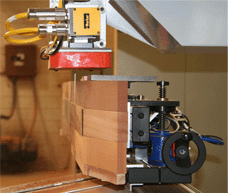
The Automatic Bandsawing System saws block or panel materials into any size, shape, or number of component parts by direct computer numeric control. The automated process generates greater yield, improves part accuracy, and reduces finished parts’ inventory.
With the right considerations, the decision to make-versus-buy becomes easier to calculate and quantify. When choosing to make the product, companies using concept feasibility and
performance testing early in the design process are the most successful. When buying is the logical choice, companies must ensure that the vendor has the support network, engineering talent, and vast application experience to reduce the total cost of ownership and decrease the risk of component failure.
Choosing a vendor
When choosing a vendor, you must consider a different set of factors. By purchasing a positioning system, companies often lock themselves into a specific design, potentially leaving the overall instrument at the mercy of one component, which can cause problems if the vendor is not top quality.
Also, customization may be limited when buying a standard solution. A positioner may not fit seamlessly or match the exact specifications of the instrument. This can drive up costs or reduce system value.
Before deciding to use a vendor, ask the following questions:
1. What is the vendor’s experience in the positioning industry? Consider the quality of their product and review the tested performance results. Talk to the engineers, understand their level of expertise, and their ability to work with customers to manufacture a solution.
2. What is their history with on-time delivery and return rates?
3. What level of customer support can they offer (global, regional, local)? Examine policies and talk to references about the service.
4. Do they offer the breadth of products you need? Examine the product line. A vendor’s solutions should demonstrate an understanding of customer needs and applications.
5. Do they offer customization?A poorly purchased positioning system can cost more in transition hardware (plates, fasteners, alignment, and so forth) than expected. If a vendor can customize the solution, you can reduce the overall cost of the system by eliminating transition plates, custom motor kits, custom hardware, and so forth.
6. How quickly can they develop a prototype for testing? Fast turnaround for testing early in the development cycle saves time and money.
7. What pre-sales materials are available? Are sizing and selection information available? Can you download CAD files?
8. What post-sales materials are available? A reliable company will offer a comprehensive list of documentation, as well as additional support and implementation services.
Do not lose sight of hidden costs
Some of the most critical considerations are often the most overlooked. Hidden costs can sidetrack in-house projects and delay time-to-market. Companies often consider design costs, but do not recognize the increased inventory and higher overhead that may accumulate to keep lead time short. Labor costs occur anytime someone has to touch the order and to expedite, track, receive, inventory, pick, or inspect it. This may not seem significant, but when looking at positioner assemblies that include up to 30 components, time quickly becomes a production concern.
: Design World :

Leave a Reply
You must be logged in to post a comment.