Linear motors are essential to controlling linear motion in manufacturing processes. Linear Motion Tips recognizes this and provides engineers and manufacturing professionals with current and comprehensive articles about linear motors and linear motion technology.

Aerotech ANT130-5-V Vertical Lift Stage

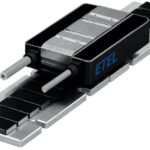
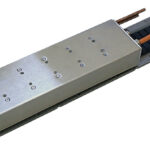
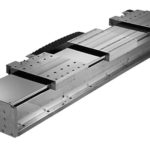
Aerotech’s ANT130-5-V is a linear-motor-driven wedge-style vertical lift stage that provides the exceptional resolution, accuracy, and in-position stability required in nanopositioning applications, all while offering travel up to 5 mm. It is a precision stage that is perfectly at home in industrial applications. The ANT130-5-V was designed for stand-alone use or can be seamlessly integrated with other stages in the Aerotech ANT stage family for a superior multi-axis nanopositioning system.

Aerotech-ANT130-5-V-Vertical-Lift-Stage

ANT130-5-V stages utilize advanced direct-drive technology, pioneered by Aerotech, as well as anti-creep crossed-roller bearings to achieve the highest level of positioning performance. Aerotech direct-drive technology is non-cogging, noncontact, high-speed, high-resolution, and high-accuracy. The lack of hysteresis or backlash enables accurate and repeatable nanometer motion. The unique drive and bearing combination, packaged in an extremely compact profile and footprint, offers tangible advantages in high-precision positioning applications such as disk-drive fabrication, fiber alignment, optical delay element actuation, sensor testing, and scanning processes that demand smooth, precise, stable, and repeatable motion.

The ANT130-5-V family has universal mounting and tabletop patterns that allow for easy system integration. Two, three, or more axes can be easily combined for flexible system designs and multi-axis configurations.

Outstanding accuracy, position repeatability, and in-position stability require high system resolution. The ANT130-5-V stage’s industry-leading 2 nm minimum incremental step size provides this high level of performance.

Aerotech
www.aerotech.com

G4 Stepper Motor Linear Actuators from Haydon Kerk

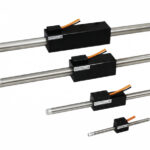
Waterbury, CT - Haydon Kerk Motion Solutions, Inc offers an entire line of high output can stack linear actuators. The Haydon line of high output can stack actuators include the 20mm, 25mm, and 35mm frame sizes. Compact, robust, and powerful, these linear actuators easily outperform all other offerings of similar size in the marketplace today.

Haydon-Kerk-G4_Stepper_Motor

The Haydon high output linear actuators were designed and built with performance and durability in mind. Technical enhancements include optimized stator tooth geometry, high energy neodymium magnets, custom engineered plastics, and larger ball bearings for greater rotor support for maintaining accuracy and repeatability over a long life.

The high output can stack line provides exceptionally high force-to-size ratios and is ideal for a variety of applications including precision medical equipment, scientific instrumentation, scanning devices, printing equipment, advanced optics, and other mechanisms requiring high force in a compact size.

The linear actuators are available in a variety of resolutions (linear travel per step). There are 3 configurations available including captive, non-captive, and external linear offering a variety of stoke lengths.

Haydon Kerk
www.HaydonKerk.com

New Linear Motor Technology from GF AgieCharmilles

June 23, 2010 by admin  
Filed under Linear Motors

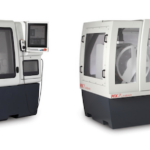
GF AgieCharmilles (www.gfac.com/us) is proud to announce the HSM 400U LP that is designed for supreme surface quality and ultimate precision. The HSM 400U LP offers five-axis simultaneous ultra-speed machining and delivers precision and powerful performance on all five axes.

The HSM 400U LP is extremely fast and dynamic and achieves speed of up to 150RPM on the swivel axis and up to 250RPM on the rotational axis, with a 220° B-axis swivel range. The machining center utilizes a liquid-cooled, linear direct drive motor technology that allows high dynamic rigidity and short setting times of the attitude control. Moreover, the linear direct drive is combined with central oil lubrication to ensure excellent, long-term precision and reduce friction-induced wear.

With powerful vector spindles in 30,000RPM, 42,000RPM or 54,000RPM, the HSM 400U LP also offers excellent part detail and surface finish, while reducing the machining time for finishing and semi-finishing operations. Its 1.7g acceleration and high dynamics help maximize spindle utilization and help facilitate the reduction of non-productive time.

The new HSM 400U LP has the capability for 24/7 unattended machining through the optional pallet changer with 20/48 pallets. The fully integrable pallet magazine further improves the equipment’s automation potential. While the machine is cutting, the pallet changer can be loaded, resulting in a minimum idle time for the machining center.

The machine is equipped with smart machining modules and a Heidenhain iTNC 530 control system, which offer advanced levels of monitoring. The system allows the equipment to automatically check and evaluate workpieces and tools, perform measurements of the workpiece and inspect tools for breakage. Moreover, the smart machine modules automatically calibrate machine geometry, monitor spindle vibration and transmit status messages to an operator’s mobile phone.

G4 19000 Series Can-stack Stepper Motor Linear Actuator from Haydon Kerk

Waterbury, CT – Haydon Kerk Motion Solutions, Inc.  introduces the G4 19000 Series Can-stack Stepper Motor Linear Actuator, built for extended reliability and high performance. This is the 3rd linear actuator size added to the Haydon™ line of high output can-stacks offering superior force output and reliability compared with similar stepper motor linear actuators in the marketplace today.

The 19000 Series is a 20mm linear actuator in the G4 line of products that leverages the same improvements as the recently released 25mm and 36mm linear actuators. Technical enhancements include optimized stator tooth geometry, high energy neodymium magnets, custom engineered plastics, and larger ball bearings for greater rotor support and high axial loading capability.

The G4 19000 Series provides a high linear force-to-size ratio and is ideal for precision linear motion in a variety of applications including medical equipment, bar code scanning devices, printing equipment, laboratory instrumentation, and other mechanisms requiring high force and extreme durability from a small linear actuator package.

There are 3 configurations available as with other Haydon stepper motor linear actuators; Captive, Non-Captive, and External Linear.

Haydon Kerk Motion Solutions, Inc.
www.HaydonKerk.com

Rethinking the Micro Linear Motor

April 12, 2010 by admin  
Filed under Linear Motors

Up until now, linear motors have been designed primarily as flat stage motors complete with cradle and guide – a format that is not necessarily suitable for every application. But a new rotationally symmetrical rotor design together with a rectangular, flange-mountable stator, enables an almost universally applicable fit.


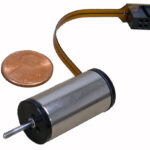
The LM 1247 motor from MicroMo is a typical example of small direct drive linear servomotors. A three-phase delta-wound coil drives the output shaft containing embedded permanent magnets, while Hall Effect sensors monitor shaft position.

The new design is largely driven by application needs, with the fact that automation and discrete applications increasingly rely on local, compact direct drives. Conventional drive concepts for translating rotational to linear motion using dc drives are available, but the smaller they become the more maintenance they tend to require.

Traditionally, there are three construction types suitable for small linear actuators: pneumatic drives, small or micromotors with spindle gears, and linear electric motors.

A pneumatic drive requires a pneumatic cylinder with a compressed air system and expensive pipe or tube to operate. It involves the compression of air at an inlet port to drive a piston that in turn drives a rod. Such a setup is very simple and effective. Pneumatic linear actuators are also easy to assemble, can produce a lot of power and have very fast actuation times. On the down side, they can be difficult to adjust and not easily controllable. Pneumatic systems may not be cost effective either, as wear and mean runtime are based on a clean air system and environment. But perhaps most importantly, in a micro drive environment that needs ultra accurate positioning, this would not be a practical situation.

Micro motors with spindle gears are another linear actuation method. Here, the accuracy depends on the type of lead screw used. So the pitch and run out along with the general hysteresis of the device, including backlash, will greatly affect the precision. In general, micro motors with spindle gears are capable of producing very high precision and accurate motion, but this comes at much higher cost of using the highest quality lead screws with the best precision and accuracy.


The stator measures just 12.5 x 19.9 x 49.4 mm (W x H x L), including power connection. The rotor bar comes in two versions, each 6.3 mm in diameter and 82 or 154 mm long. This makes stroke lengths of up to 20 or 80 mm possible, which is sufficient for many microdrive applications.
The resolution or smallest possible movement of the rotor bar is just 6 µm, and repeatability (maximum deviation on multiple movements of the same kind) is 40_µm. Three linear Hall sensors combined with a motion controller limit the maximum positional error, or the difference between the set and measured position of the system, to 120_µm. As all values are determined solely electronically, mechanical tolerances, wear and tear and thermal expansion of components are of no consequence.

Linear Electric Motors
Traditional linear motors were basically a permanent-magnet rotary motor rolled out and laid flat. Imagine the stator and rotor being cut along a radial plane and then unrolled so that they could provide linear thrust. Energizing the stationary part of the motor causes motion in the moving part, which typically contains some type of conductive material.

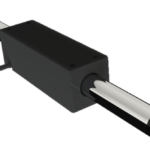
The new linear electric motor design goes back to rotary ideas. The motor itself is contained within a nonmagnetic steel housing. A self-supporting coil sits inside, along with the sleeve bearing of the forcer rod made out of special slide-bearing material. The coils are glued and connected together and after the insertion in the housing a plastic injection makes for a self-supporting structure so that there is no core for the structure rigidity. Inside the forcer rod-a high-precision sliding cylinder-are small ultrastrong permanent magnets in the shape of a disk. The rod-magnet assembly is free to move inside and out of the coil. As the coil is energized and de-energized, this produces a magnetic field which can move the forcer rod forward or backward, creating motion. A circuit board with electronics for the three Hall sensors that determine positioning is hidden under the top cover, along with the power connection.


Traditional linear motors are essentially a permanent-magnet rotary motor rolled out and laid flat. Energizing the coil assembly produces motion.

This new design provides for almost floatational movement of the forcer rod in the sleeve bearing. Because the magnetic field is so close to the bearings, the rotor and stator operation is like a magnetic levitation train where the forcer rod “floats” in the magnetic field. This reduces the friction by orders of magnitude over traditional linear motors. Wear is limited and is a direct result of rod speed and rod loading this also limits the heat generated.

This design adds all of the benefits of a pneumatic cylinder (power, fast actuation times, and quiet operation) with the added flexibility of an electromechanical motor, such as the size and being able to operate in a dual push and pull mode.

Moving the forcer rod by hand reveals no cogging force, just a smooth motion without resistance. In other types of linear motors this residual cogging force can be clearly felt. This makes for sticktion-free operation and improvers the overall efficiency of the motor.

Discuss this on the Engineering Exchange:

MicroMo
www.micromo.com

::Design World::

Nippon Pulse introduces L427 Series Linear Shaft Servomotor

February 25, 2010 by admin  
Filed under Linear Motors

RADFORD, VA — Nippon Pulse has introduced the L427 series, a linear shaft servomotor that features a 5mm air gap between the forcer and magnetic shaft. In the Linear Shaft Motor (LSM) family, the L427 series is a low-maintenance linear motion solution that has applications in a wide industry range.

nippon-pulse-l427-linear-shaft-servomotor

With a 5mm air gap between the motors forcer and shaft, users have more flexibility when machining their device to level. It is also a good motion solution when a user does not have the ability or resources to do an accurate alignment of the forcer and the shaft.

The L427 series is an optimal solution in environments where there is the potential for matter to stick to and build up on the shaft. When there is the potential for debris to build up on the shaft, the 5mm air gap will prevent the motor from jamming and will also increase the time required between cleanings.

The L427 features a usable stroke length between 100 and 4,600 millimeters and has a constant force of 110N. The motor’s peak force is 450N, while its force constant is 31(Kf) N/Amps. Other features of the product include a 42.7 mm shaft diameter, a 3.6A continuous current, a 14A peak current, a 10 V/m/s back EMF, and a 3kg forcer weight.

Nippon Pulse’s Linear Shaft Motor has three basic concepts. It is simple, consisting of only a magnetic shaft and a forcer. The motor is also high precision, taking advantage of its ironless make-up to offer zero cogging, while giving complete stiffness. Being non-contact, the shaft motor has a non-critical air-gap that eliminates variation in force over the entire stroke of the device.

Nippon Pulse America, Inc.
www.nipponpulse.com

Ceramic Linear Piezo Motor from Physik Instrumente

February 3, 2010 by Miles Budimir  
Filed under Linear Motors

Auburn, Mass. – PI (Physik Instrumente) introduces the new N-216 NEXLINE® high-load piezo linear motors. These highly precise nanopositioning actuators provide travel ranges to 20mm with a resolution of 0.03nm, and push/pull forces to 600N (130lbs) and holding forces to 800N (177lbs).

The piezoceramic clamping and shear elements act directly on a moving runner coupled to the load. For maximum velocity, and long distance movements, the runner can be driven in full step mode. Extremely uniform motion and constant velocity is achieved with the nanostepping mode.

The N-216 linear motors come in two versions for open- or closed-loop operation, as well as in two different load configurations. Closed-loop versions are equipped with a linear encoder for direct position measurement of the moving runner. The encoder features 5nm resolution over the full travel range.

Applications include high-end ultra-precision manufacturing and semiconductor test equipment to astronomy and high energy physics applications. Extreme reliability makes them ideal for applications in difficult-to-access internals of instruments, requiring nanometer-realm adjustment and/or vibration cancellation.

For datasheets or more information, email info@pi-usa.us or visit www.pi-usa.us.

SQUIGGLE® RV Micro Motion System

January 15, 2010 by admin  
Filed under Featured, Linear Drives, Linear Motors

Victor, NY – New Scale Technologies, Inc. announced a breakthrough in piezo motion control system design. The SQUIGGLE RV reduced voltage linear drive system consists of a SQL-RV-1.8-6-12 SQUIGGLE motor and NSD-2101 drive ASIC. It is the industry’s first miniature piezo motor drive solution with a driver chip that is smaller than the motor and driven directly from battery power as low as 2.3 VDC without the need for a voltage boost.

The SQUIGGLE RV motor is New Scale’s next-generation piezo micro motor, using state-of-the-art, multi-layer piezo technology from TDK-EPC (www.epcos.com) to reduce the input voltage requirements of this tiny motor – still the world’s smallest linear motor at 2.8 x 2.8 x 6 mm. The NSD-2101 driver was developed for this new motor in partnership with austriamicrosystems (www.austriamicrosystems.com) using advanced integrated circuit designs and patented control systems. This smart IC measures only 1.8mm x 1.8mm and drives the SQUIGGLE RV motor directly, without the need for an external boost circuit.

SQUIGGLE-RV-linear-drive-system

The SQUIGGLE RV linear drive system is more than five times smaller and uses 40% less power than comparable electromagnetic linear drive systems.

Read more

Linear Motor Axes Deliver Cutting-edge Motion

January 8, 2010 by admin  
Filed under Featured, Linear Drives, Linear Motors

With acceleration values of 140 m/s², Festo linear motor direct drives are the perfect actuators for fast acceleration with high precision, such as is required in photovoltaics production, medical technology, the electronics industry or the assembly of small parts in the clock and watch-making industry.

Short strokes in less than 20 milliseconds: the linear motor drive DNCE-LAS. (Photo: Festo)

The electric linear motor drives ELGL-LAS, DNCE-LAS and DFME-LAS accelerate at one and a half to four times the rate of all other electric and pneumatic drives used in automation technology. They are also two to three times faster than electric axes with a spindle or belt drive. And all this to an accuracy of 10 µm. This makes linear motor axes the ideal choice for short assembly times, where not only high speeds but above all high rates of acceleration are required.
Read more

Saia® UAL series Linear Stepper Motors from Johnson Electric

October 22, 2009 by admin  
Filed under Linear Motors, Linear Stepper Motors

VANDALIA, OH – Johnson Electric introduces Saia® UAL series Linear Stepper Motors. These motors deliver constant positioning force up to 30 N over the full travel distance of up to 15 mm, at speeds up to 4.16 mm/s at 200 Hz. They feature a unique removable bayonet-style flange for easy mounting, a flexible design that easily accommodates various custom requirements, and a compact 20 x 30 mm footprint to deliver advanced performance in space restricted applications.

Johnson-Electric-Saia-Stepper-Motor.jpg

Saia UAL series motors are available in unipolar or bipolar models, with performance attributes that make them well suited for use in instrumentation, valve control, dispensing, metering pump, auger and medical automation applications.

Johnson Electric
www.saia-motor-usa.com

Next Page »